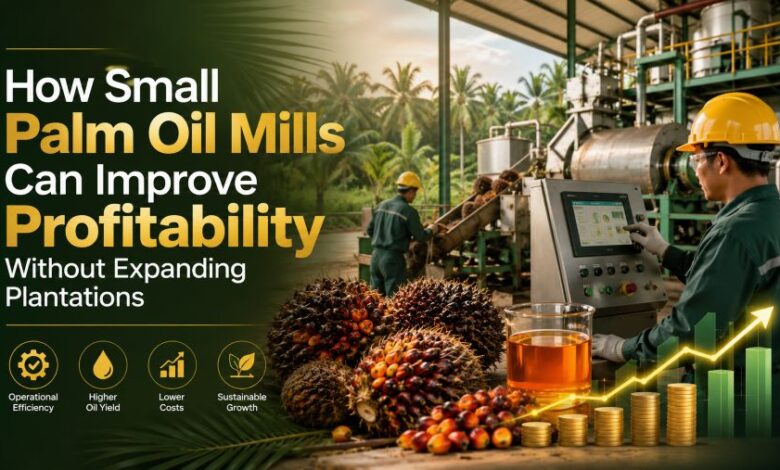
Small palm oil mills often assume that increasing profit requires purchasing more fruit, planting additional land, or expanding processing capacity. However, plantation expansion brings higher land costs, labor requirements, environmental concerns, and longer investment cycles.
For many small mills, the fastest route to stronger profitability is improving how existing raw materials, equipment, labor, and by-products are managed. Even modest improvements in oil recovery, energy use, maintenance, and product quality can create measurable financial benefits without increasing plantation acreage.
Improve Fresh Fruit Bunch Handling
Fresh fruit bunches should be processed as soon as possible after harvesting. Long delays can increase free fatty acid levels, reduce crude palm oil quality, and lower the selling price.
Small mills can improve fruit handling by coordinating harvesting schedules with daily processing capacity. Fruit should be transported efficiently, protected from excessive impact, and stored for the shortest possible time.
A simple receiving system can also help operators record fruit weight, arrival time, source, and visible quality. These records make it easier to identify suppliers or harvesting practices that consistently produce better results.
Increase Oil Extraction Efficiency
Oil losses may occur during sterilization, threshing, digestion, pressing, clarification, and fiber discharge. Although each loss may appear small, the total can significantly reduce monthly revenue.
Mill operators should regularly inspect pressed fiber, empty fruit bunches, sludge, wastewater, and recovered nuts. Excessive oil in any of these materials may indicate poor temperature control, incorrect pressure, worn components, or unstable feeding.
Installing a properly selected palm oil processing machine does not automatically guarantee high extraction efficiency. The equipment must be matched to fruit quality, processing volume, operating conditions, and maintenance capability.
Operators should also monitor key parameters such as sterilization time, digester temperature, press pressure, dilution water, and clarification temperature. Consistent process control often produces better financial results than simply running machines at maximum speed.
Reduce Unplanned Equipment Downtime
Unexpected equipment failure can interrupt production while harvested fruit continues to deteriorate. The mill may lose both processing time and raw material quality.
Preventive maintenance is usually more economical than emergency repair. Mills should create a basic maintenance schedule covering lubrication, bearing inspection, belt tension, steam lines, press components, motors, pumps, and electrical systems.
Frequently used spare parts should be kept on-site, especially when replacement components have long delivery times. Maintenance records can help identify repeated failures and show whether a component should be repaired, upgraded, or replaced.
Training operators to recognize unusual noise, vibration, leakage, temperature, and pressure changes can prevent minor problems from becoming major breakdowns.
Control Energy and Steam Consumption
Sterilization, digestion, pressing, clarification, and kernel processing require substantial energy. Poorly insulated steam pipes, leaking valves, unstable boiler operation, and oversized motors can increase processing costs.
Small mills should inspect steam systems regularly and repair leaks quickly. Insulating pipes, tanks, and heated processing areas can reduce heat loss and shorten warm-up time.
Electric motors should also be matched to the actual operating load. Machines that frequently run empty should be switched off or controlled through a better production schedule.
Where practical, palm fiber and shells can be used as boiler fuel. This reduces dependence on purchased energy while creating value from materials that might otherwise become waste.
Improve Product Quality and Selling Price
Profitability depends not only on how much oil is produced but also on its quality. Buyers may offer lower prices for crude palm oil with excessive moisture, impurities, oxidation, or free fatty acids.
Mills should control fruit freshness, processing temperature, water addition, settling time, filtration, and storage conditions. Finished oil tanks should be clean, covered, and protected from water contamination.
Simple laboratory testing can help operators monitor moisture, dirt, and acidity before dispatch. More consistent quality may support better buyer relationships, fewer rejected deliveries, and stronger contract prices.
Generate Revenue from Palm Oil By-Products
Palm oil production creates empty fruit bunches, fiber, shells, palm oil mill effluent, sludge, and kernels. These materials should be treated as potential resources rather than disposal problems.
Fiber and shells can support boiler operation or be sold as industrial fuel. Empty fruit bunches may be composted, mulched, or processed into biomass products. Palm kernels can be sold to kernel crushing facilities or processed further where market conditions justify the investment.
Some mills also recover residual oil from sludge and wastewater streams. The financial value depends on recovery cost, local regulations, and the amount of oil available.
Upgrade Only the Most Important Processing Sections
A complete factory replacement is rarely necessary. Small mills can begin by identifying the stage responsible for the largest product loss, energy waste, labor demand, or quality problem.
One mill may benefit from a better sterilizer, while another may need an improved screw press, clarification tank, kernel separator, pump, or filtration system. Modular upgrades reduce capital pressure and allow the mill to measure results before making the next investment.
When evaluating food processing equipment, owners should consider more than purchase price. Capacity accuracy, energy consumption, cleaning requirements, spare-part availability, local technical support, and expected service life all influence the real return on investment.
Strengthen Production Records and Cost Control
Many small mills know their total monthly output but cannot identify where money is being lost. Basic production records can make profitability easier to manage.
Useful data includes fruit input, oil output, kernel output, fuel use, electricity consumption, labor hours, downtime, maintenance expenses, and rejected product volume. Comparing these figures by day or production batch can reveal unusual changes.
For example, rising fruit consumption per ton of oil may indicate lower-quality fruit or reduced extraction performance. Higher energy use may reveal steam leakage or inefficient machine operation.
Focus on Efficiency Before Expansion
Small palm oil mills do not always need larger plantations to earn more. Better fruit handling, improved oil recovery, reliable maintenance, controlled energy use, higher product quality, and profitable by-product utilization can all strengthen financial performance.
By improving one processing stage at a time and measuring the results, mill owners can increase output value while controlling investment risk. In many cases, the most profitable growth comes not from processing more fruit, but from gaining more value from every fruit bunch already entering the mill.