How Column Palletizers Reduce Labor Costs in Manufacturing Operations

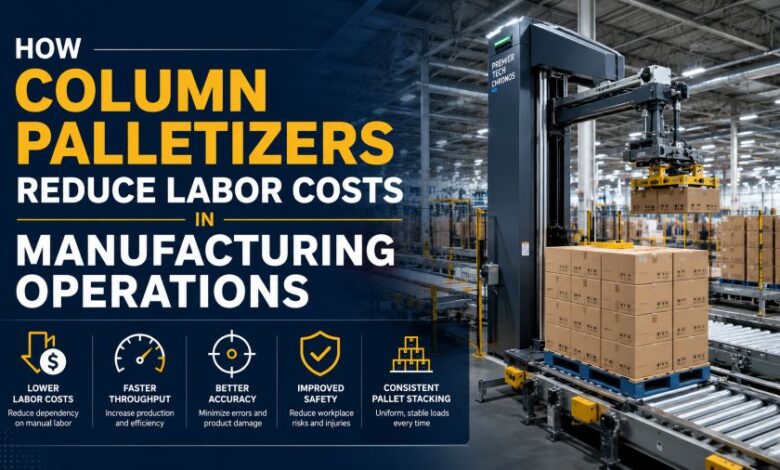
Labor costs and workforce availability are key factors affecting modern manufacturing efficiency. Column palletizers provide reliable end-of-line automation for stacking bags, cartons, boxes, and packaged products, reducing manual labor, improving consistency, and optimizing production costs.
Reducing Dependence on Manual Palletizing Labor
Traditional palletizing operations often require workers to repeatedly lift, move, and arrange products at the end of production lines. For factories with high production volumes, this process may require multiple operators working continuously throughout each shift.
A typical manual palletizing station may need:
- 2–4 operators per production line
- 8–12 working hours per day
- Additional temporary workers during peak seasons
Assuming an average labor cost of US$20–30 per hour, a factory operating two shifts per day may spend tens of thousands of dollars annually on palletizing labor alone.
Column palletizers automate these repetitive tasks by using mechanical lifting, positioning, and stacking systems. This allows manufacturers to reduce direct labor requirements while reallocating employees to quality control, equipment monitoring, and other higher-value activities.
Improving Productivity with Continuous Operation
Labor cost reduction is not only related to the number of workers needed but also the productivity gained from automation.
Manual palletizing speed can vary depending on worker availability, fatigue, and product conditions. In contrast, column palletizers provide stable operation with consistent stacking performance.
Depending on the model and configuration, automated palletizing systems can typically handle:
- 10–60 products per minute
- Hundreds to thousands of packages per hour
- Multiple pallet patterns based on product requirements
For example, a factory handling 500 cartons per hour may experience productivity fluctuations during manual palletizing. With an automated column palletizer, the production line can maintain a more stable output rate and reduce bottlenecks at the packaging stage.
Reducing Labor-Related Operating Costs
Labor expenses include more than wages. Manufacturing companies also need to consider overtime payments, employee training, recruitment costs, and workplace safety management.
Column palletizers help reduce these indirect expenses by minimizing the need for workers to perform physically demanding tasks.
Common cost-saving benefits include:
- Lower overtime requirements
- Reduced employee turnover caused by repetitive work
- Less training needed for temporary workers
- Reduced workplace injury risks
For heavy products such as bags of raw materials, chemical products, agricultural goods, or construction materials, automation can significantly reduce the physical workload placed on operators.
Improving Workplace Safety and Efficiency
Manual palletizing requires workers to repeatedly lift, bend, and twist, which can contribute to fatigue and workplace injuries over time.
Column palletizers automate stacking tasks, improving workplace safety while enabling operators to focus on equipment monitoring and production control.
Many modern factories combine palletizing equipment with upstream and downstream automation, such as packaging machines, conveyors, and a depalletizer machine, creating a more efficient material handling process from production to storage.
Maximizing Factory Space and Production Flexibility
Lower labor demand contributes to more efficient production operations. Column palletizers feature a space-saving design, making them well suited for factories with limited floor space.
Compared with traditional manual palletizing areas, automated systems can:
- Reduce occupied working space
- Support standardized pallet patterns
- Connect with multiple production lines
- Improve warehouse organization
For manufacturers producing different product types, customized palletizing programs allow operators to quickly adjust stacking methods according to package size, weight, and pallet requirements.
Calculating the Return on Investment
To evaluate the financial value of a column palletizer, manufacturers should compare the equipment investment with annual savings.
A simple ROI calculation may include:
Annual Savings = Labor Cost Reduction + Productivity Improvement Value + Reduced Operational Costs
For example:
Initial investment:
- Column palletizer system: US$120,000
Annual benefits:
- Reduced labor expenses: US$60,000/year
- Lower overtime and training costs: US$15,000/year
- Productivity improvement value: US$25,000/year
Total annual benefit:
US$100,000/year
Estimated payback period:
Approximately 1.2 years
After the payback period, the system continues generating value throughout its service life, which can often exceed 8–10 years with proper maintenance.
Conclusion
Column palletizers help manufacturing companies reduce labor costs by automating repetitive pallet stacking tasks, improving productivity, and creating safer working environments. By reducing dependence on manual labor while maintaining consistent production performance, these systems provide long-term value for factories seeking higher efficiency and more competitive operations.