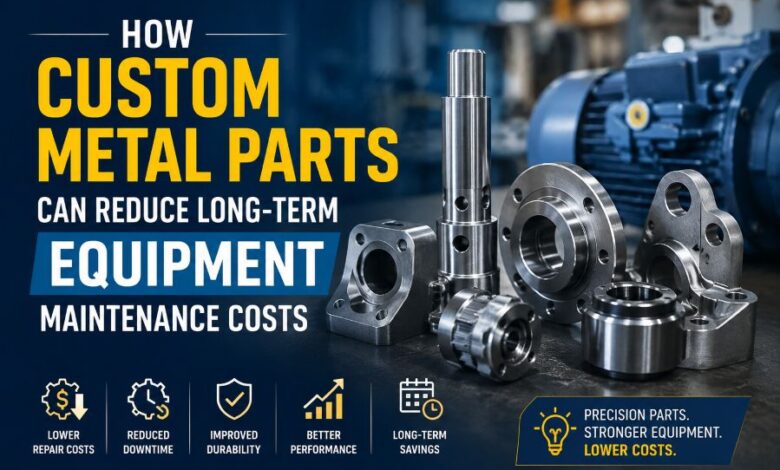
Industrial equipment is expected to operate reliably for years, often under demanding conditions involving vibration, heat, moisture, dust, chemicals, and repeated mechanical loads. However, standard replacement parts do not always match the equipment’s actual operating environment or maintenance requirements.
Custom metal parts can solve this problem by improving fit, material performance, structural strength, and ease of servicing. Although a customized component may cost more initially than a generic alternative, it can reduce repair frequency, equipment downtime, labor expenses, and premature replacement over the full service life of the machine.
Improve Component Fit and Alignment
Poorly fitted components are a common cause of equipment wear. Small dimensional differences can create misalignment between shafts, brackets, panels, guards, bearings, and mounting points.
When parts do not fit correctly, vibration and uneven loading may increase. Fasteners can loosen, joints may shift, and nearby components can experience unnecessary stress.
Custom parts are produced according to the machine’s actual dimensions, tolerances, and installation conditions. A more accurate fit reduces movement between connected parts and helps equipment maintain stable alignment during operation.
This is especially valuable when maintaining older machinery for which original replacement components are no longer available. Instead of modifying an unsuitable standard part on-site, a manufacturer can reproduce or improve the original design.
Select Materials for the Operating Environment
Generic parts are often made from materials intended for broad applications. They may not offer the corrosion resistance, hardness, temperature tolerance, or impact strength required by a specific machine.
Custom manufacturing allows the material to be selected according to real operating conditions. Stainless steel may be used in wet or hygienic environments, while hardened alloy steel may be more suitable for high-wear components.
Aluminum can reduce weight on movable covers and frames, while galvanized or coated carbon steel may provide a practical balance between strength and corrosion protection. Selecting the correct material can greatly extend component life and reduce repeated replacements.
Strengthen High-Stress Areas
Standard components are usually designed for typical loads. However, actual equipment may experience heavier products, faster operating speeds, frequent impacts, or continuous production cycles.
These conditions can cause cracks, deformation, worn mounting holes, and broken welds. Replacing the same standard component without improving its design often leads to repeated failure.
A custom part can include thicker material, reinforced corners, added ribs, stronger welds, or improved load distribution. These changes help the component withstand real operating forces rather than relying on a general-purpose design.
Engineers can also remove unnecessary weight from low-stress areas while strengthening critical sections. This creates a more efficient structure without making the entire part excessively heavy or expensive.
Reduce Corrosion-Related Maintenance
Corrosion can weaken equipment frames, enclosures, brackets, guards, platforms, and fasteners. It may also create contamination risks in food, pharmaceutical, and chemical production environments.
Custom metal parts can be designed with fewer moisture traps, smoother surfaces, sealed joints, drainage openings, and appropriate protective finishes. These details help prevent water, chemicals, and cleaning fluids from remaining on the component.
Professional Custom Sheet Metal Fabrication can also produce enclosures and protective covers that shield motors, sensors, wiring, and control systems from dust, water, and accidental impact.
Better environmental protection reduces electrical failures, cleaning time, surface repairs, and the need to replace damaged internal components.
Make Parts Easier to Remove and Replace
Maintenance costs are influenced not only by the price of replacement parts but also by the time required to access them. A small internal component may take hours to replace if guards, panels, or surrounding assemblies are difficult to remove.
Custom designs can improve accessibility by adding removable covers, inspection doors, quick-release fasteners, lifting points, and modular sections. Maintenance teams can then reach important components more quickly.
A well-designed part may also reduce the number of fasteners or tools required during servicing. This shortens maintenance procedures and lowers labor costs, especially for equipment that requires frequent inspection or cleaning.
Protect More Expensive Components
Some custom parts are designed mainly to protect higher-value equipment. Examples include machine guards, motor covers, sensor brackets, cable trays, heat shields, splash panels, and impact barriers.
A properly designed protective component may prevent a relatively minor event from damaging an expensive motor, gearbox, control unit, or monitoring device. Replacing the protective part is usually much less costly than repairing the equipment behind it.
Custom guards can also be shaped around moving parts without interfering with airflow, product movement, or routine adjustments. This provides protection while maintaining equipment performance.
Support Preventive Maintenance
Custom metal parts can include features that make inspection easier. Sight openings, access panels, removable screens, drain ports, and clearly positioned mounting points allow technicians to check equipment condition without extensive disassembly.
When inspections are easier, maintenance teams are more likely to identify loose fasteners, leakage, wear, overheating, and material buildup before these issues cause a breakdown.
Custom components can also support the installation of sensors for temperature, vibration, pressure, or alignment monitoring. These sensors provide useful information for preventive and predictive maintenance programs.
Reduce Equipment Downtime
Unexpected downtime can be more expensive than the failed component itself. Production may stop, workers may remain idle, deliveries may be delayed, and unfinished products may be damaged.
Custom metal parts improve reliability by addressing the real cause of repeated failures. Instead of repeatedly replacing a weak bracket, poorly fitted cover, or corroded panel, the business can install a stronger and more suitable version.
Manufacturers may also produce spare parts in advance based on approved drawings. Keeping critical custom components in stock reduces the waiting time when replacement becomes necessary.
Standardize Parts Across Multiple Machines
Factories sometimes operate several machines with slightly different brackets, covers, supports, and mounting systems. This increases the number of spare parts that must be stored and makes maintenance planning more complicated.
Custom redesign can standardize certain components across several machines. A common bracket, guard, panel, or mounting plate may replace multiple similar versions.
Standardization reduces inventory requirements, simplifies purchasing, and makes it easier for technicians to complete repairs. It also supports future equipment upgrades because compatible components can be reused across different production lines.
Focus on Total Ownership Cost
The cheapest component is not always the most economical choice. A low-cost part that fails repeatedly can create greater long-term expenses through replacement purchases, emergency labor, production losses, and damage to connected equipment.
Custom metal parts reduce maintenance costs by improving fit, material selection, strength, protection, accessibility, and service life. They can also solve recurring problems that standard replacement parts fail to address.
By evaluating the total cost of ownership rather than only the initial purchase price, businesses can use custom components to improve equipment reliability, reduce downtime, and achieve more predictable maintenance expenses over the long term.