Hili Archaeological Park: Location, Timings, Tickets and Entry Fee
Hili Archaeological Park is a historic attraction in Al Ain, Abu Dhabi, where visitors can see ancient tombs, settlements, and remains dating back thousands of years. Entry is free, and the site is part of the UNESCO-listed Cultural Sites of Al Ain.

Introduction
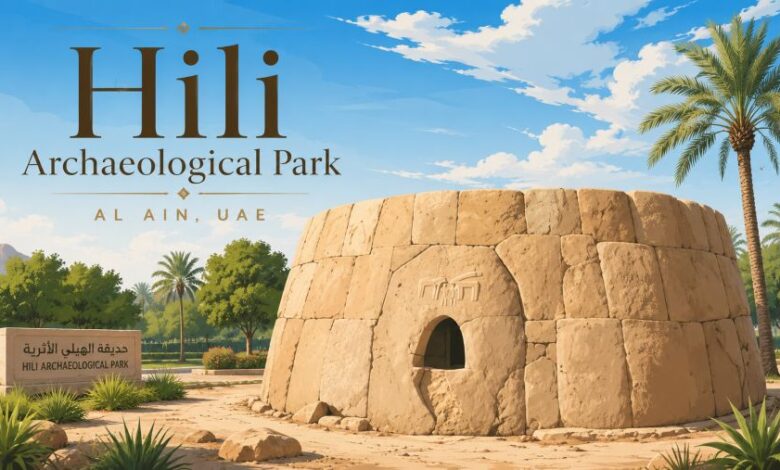
Hili Archaeological Park is one of the most important heritage places in the United Arab Emirates. It combines a green public park with archaeological remains from the Bronze Age and Iron Age.
The best-known attraction here is the Hili Grand Tomb, a large circular burial monument that is around 4,000 years old.
Visitors looking for the location, timings, ticket price, entrance fee, and main things to see will find the important verified details below.
Hili Archaeological Park Quick Facts
| Detail | Information |
|---|---|
| Name | Hili Archaeological Park |
| Location | Al Ain, Abu Dhabi, UAE |
| Address | Mohammed Bin Khalifa Street, Al Ain |
| Type | Archaeological site and public park |
| Entrance Fee | Free |
| Ticket Price | AED 0 for normal entry |
| Main Attraction | Hili Grand Tomb |
| Historical Periods | Bronze Age and Iron Age |
| UNESCO Status | Part of the Cultural Sites of Al Ain |
| UNESCO Inscription Year | 2011 |
| Suitable For | Families, history lovers, tourists and students |
Where Is Hili Archaeological Park Located?
Hili Archaeological Park is located on Mohammed Bin Khalifa Street in Al Ain, in the Emirate of Abu Dhabi.
The archaeological area lies outside the central part of Al Ain and is easy to reach by road.
Al Ain is known for its oases, mountains, museums, forts, gardens, and ancient sites. Travellers exploring more attractions and useful UAE information can also visit AE Businesses for guides related to places, companies, and services across the country.
Visitors should remember that Hili Archaeological Park and Hili Fun City are different attractions. One focuses on history and archaeology, while the other is an entertainment destination.
Hili Archaeological Park Timings
Official UAE listings currently show slightly different opening hours for the park.
One official Abu Dhabi tourism listing gives the operating time as:
7:00 AM to 12:00 midnight
An Al Ain municipal parks listing gives:
6:00 AM to 11:00 PM
Because these two official schedules are not exactly the same, visitors should confirm the latest opening time before making a time-sensitive journey.
The attraction is generally open daily.
Opening hours may also change during public holidays, special events, Ramadan, maintenance work, or other temporary situations.
Hili Archaeological Park Ticket Price
Normal entry to Hili Archaeological Park is free.
Entrance Fee
AED 0
There is currently no standard paid general-admission ticket required to enter the public archaeological park.
This makes the attraction a useful choice for families and travellers who want to explore an important historic place in Al Ain without paying an entrance charge.
Special programmes or organised events may have separate conditions, so these should be checked individually if visitors are attending a particular activity.
Why Is Hili Archaeological Park Famous?
The site is famous because it preserves evidence of communities that lived in the Al Ain region thousands of years ago.
Archaeological discoveries in the Hili area have helped researchers understand ancient:
- Farming
- Settlements
- Burial traditions
- Building methods
- Water management
- Daily life
- Trade and community organisation
The area contains archaeological remains from both the Bronze Age and Iron Age.
Some evidence from Hili dates back to around 3000 BCE, making the location extremely important for understanding the early history of the UAE.
Hili Grand Tomb
The Hili Grand Tomb is the best-known monument inside the park.
It is a large circular stone tomb dating to approximately 2000 BCE.
The structure is around 12 metres in diameter and is believed to have been used as a communal burial place.
The tomb has two entrances and includes carved images showing humans and animals.
Animal figures represented on the monument include creatures such as lions and oryx.
The tomb seen by visitors today has been reconstructed to help preserve and explain this important archaeological feature.
Its size and design show that ancient communities living in this region had developed organised building skills thousands of years ago.
How Old Is Hili Archaeological Park’s History?
The modern public park is much newer than the archaeological remains inside and around it.
Human activity in the Hili area goes back several thousand years.
Archaeological evidence includes important periods such as:
Around 3000 BCE
Evidence shows the presence of an early agricultural settlement.
Hili Site 8 has been identified as containing some of the earliest known evidence of an agricultural village in the UAE.
Bronze Age
The wider archaeological area contains settlements, tombs, and structures dating broadly from around 3000 BCE to 1300 BCE.
Umm an-Nar Period
Hili became especially important during the Umm an-Nar cultural period.
Communities built large tombs, towers, and settlements during this era.
The Hili Grand Tomb is one of the clearest surviving examples linked with this ancient period.
Iron Age
From around 1300 BCE to 300 BCE, communities continued to live and farm in the area.
One of the most important developments was the use of falaj irrigation systems.
These underground water channels helped move groundwater to farms and settlements in the dry desert environment.
Archaeological Sites Around Hili
The wider Hili archaeological area contains more than the main public park.
Several important locations have been studied by archaeologists.
Hili 1
Hili 1 includes evidence of a large circular mudbrick structure.
It was one of the important areas investigated during early archaeological work.
Hili 2
Hili 2 contains the remains of an Iron Age village.
More than ten well-preserved houses have been identified there.
Objects found during excavations have also helped researchers understand how people stored food and lived in the settlement.
Hili Site 8
This area is especially important because it contains evidence of an agricultural village dating to approximately 3000 BCE.
It provides valuable information about some of the earliest settled farming communities known in the UAE.
Hili North Tombs
Important ancient tombs are also located north of the main archaeological park.
These are connected with the wider prehistoric landscape of the Hili region.
Not every archaeological feature carrying the Hili name is located directly inside the landscaped public park.
UNESCO World Heritage Status
Hili forms part of the Cultural Sites of Al Ain, which became a UNESCO World Heritage property in 2011.
The UNESCO listing covers several important areas, including:
- Hili
- Hafit
- Bidaa Bint Saud
- Al Ain oasis areas
For accuracy, Hili Archaeological Park should not be described as a separate independent UNESCO World Heritage Site.
It is one part of the larger UNESCO-listed cultural landscape of Al Ain.
The World Heritage area is important because it shows how people lived, farmed, built homes, buried their dead, and managed water in a desert environment over thousands of years.
Archaeological Excavations at Hili
Modern archaeological work in the Hili region began during the 1960s.
Sheikh Zayed bin Sultan Al Nahyan invited Danish archaeologists to investigate ancient remains in the area.
Researchers later uncovered tombs, buildings, settlements, towers, farming areas, and irrigation systems.
Continued study has made Hili one of the UAE’s key archaeological locations.
Conservation projects have also been carried out to protect fragile ancient structures.
Work at Hili 2 between 2017 and 2019 focused on protecting archaeological remains and improving their preservation.
What Can Visitors See?
People visiting the park can experience both green public space and ancient heritage.
The main reason to visit is the archaeological history.
Visitors can learn about:
- Ancient tomb construction
- Early farming communities
- Bronze Age life
- Iron Age settlements
- Traditional irrigation systems
- Ancient architecture
- UAE prehistoric history
The Hili Grand Tomb is normally the most recognisable feature for first-time visitors.
The wider archaeological landscape also contains remains that show how early communities adapted to the desert environment.
Is Hili Archaeological Park Good for Families?
Yes. The attraction can be suitable for families because it combines history with outdoor public space.
Children can see real archaeological remains rather than only reading about ancient history in books.
Parents can also use the visit as an educational experience about early life in the UAE.
Because normal entry is free, families can explore the site without paying a standard admission charge.
Young children should still be supervised around historic remains and outdoor areas.
Best Time to Visit
The attraction can be visited throughout the year, but outdoor temperatures in Al Ain can become very high during summer.
Early morning or evening may therefore feel more comfortable during hotter months.
During cooler UAE weather, visitors may find it easier to spend more time walking around the park.
Useful items may include:
- Drinking water
- Comfortable shoes
- Sun protection
- Light outdoor clothing
- A hat during sunny hours
Visitors should respect archaeological remains and follow all signs or instructions at the site.
How Long Do You Need at the Park?
There is no official fixed visit duration.
The amount of time needed depends on personal interest.
Someone mainly interested in seeing the Hili Grand Tomb may spend less time, while visitors interested in archaeology, photography, and the surrounding park may stay longer.
It is better not to treat unofficial estimates such as one, two, or three hours as fixed requirements.
Is Hili Archaeological Park Free?
Yes. Current official UAE information states that normal entry is free.
Visitors therefore do not normally need to purchase a general entrance ticket.
This is one of the most common questions people search before visiting, and the simple answer is:
Hili Archaeological Park entrance fee: AED 0.
Is the Site Worth Visiting?
The park may be especially interesting for people who enjoy ancient history and UAE heritage.
Unlike a modern entertainment attraction, its value comes from seeing evidence of communities that lived in the region thousands of years ago.
The Grand Tomb, early farming evidence, ancient settlements, and irrigation history make the location different from a normal city park.
It can also fit well into an Al Ain trip that includes forts, museums, oases, mountains, and other cultural locations.
Frequently Asked Questions
Where is Hili Archaeological Park?
It is located on Mohammed Bin Khalifa Street in Al Ain, Abu Dhabi, United Arab Emirates.
What is the Hili Archaeological Park entrance fee?
Normal entry is free. The standard entrance cost is AED 0.
Do I need a ticket?
A paid general-admission ticket is not currently required for normal entry.
What are the opening hours?
Official UAE sources currently differ slightly. One lists 7:00 AM to midnight, while a municipal listing shows 6:00 AM to 11:00 PM. Visitors should confirm current hours before travelling.
What is Hili Archaeological Park famous for?
It is known for Bronze Age and Iron Age archaeological remains, including the approximately 4,000-year-old Hili Grand Tomb.
Is Hili Archaeological Park a UNESCO site?
It is part of the Cultural Sites of Al Ain UNESCO World Heritage property, which was inscribed in 2011.
How old is the Hili Grand Tomb?
It dates to around 2000 BCE, making it approximately 4,000 years old.
Is Hili Archaeological Park the same as Hili Fun City?
No. They are separate attractions in Al Ain.
Final Words
Hili Archaeological Park offers visitors a simple way to explore thousands of years of UAE history in Al Ain. Its most famous monument is the Hili Grand Tomb, while the wider archaeological area contains evidence of early farming, ancient villages, burial sites, buildings, and water systems.
Normal admission is free. Current official listings show slightly different daily opening hours, so checking the latest schedule before visiting is sensible.
For travellers interested in archaeology, history, and the early development of life in the UAE, Hili remains one of Al Ain’s most important cultural attractions.