ERP Readiness for UAE e-Invoicing: A Practical Checklist for Finance Teams

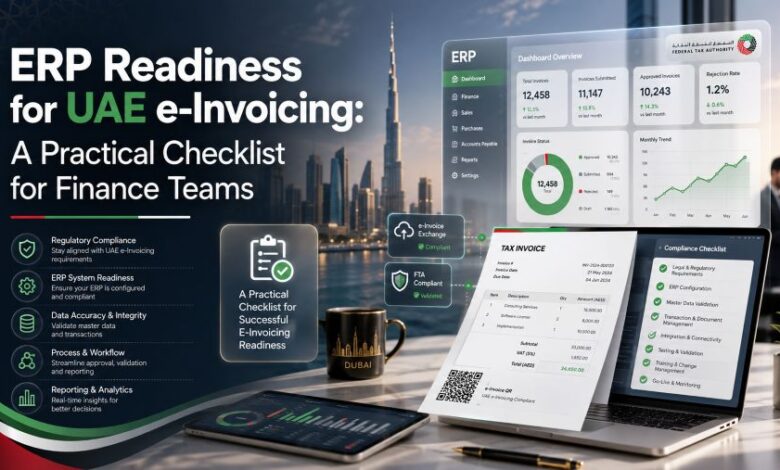
All over the world, tax systems are going digital. Governments across Europe and Southeast Asia are transitioning away from paper-based invoicing to electronic data reporting and near real-time data exchange. The UAE is going the same way.
Businesses operating in the UAE are now preparing for more structured digital invoice reporting. If you’re dealing with VAT compliance, looking ahead to upcoming UAE e-Invoicing requirements, or just looking to modernise your finance operations, your ERP system is at the heart of it all. The hard part, is that most ERP systems were not originally designed with today’s compliance needs in mind.
Businesses add new modules, change processes, and gather data quality problems over years. When e-Invoicing UAE requirements become operational, these gaps can quickly turn into compliance, reporting, and reconciliation issues. The good news is that businesses that start early have time to fix them in a structured way.
They have time to resolve data issues, test integrations, and train their teams without the pressure of last-minute deadlines. This checklist gives CFOs, finance heads, tax managers, and ERP teams a practical way to understand what to check, who should be involved, and where to begin.
Why ERP Integration is Important
Ultimately, ERP integration is about connecting your invoicing, accounting, inventory, and tax processes through a single system that’s synchronized across the organization. Instead of finance using one tool and operations using another, an integrated ERP helps create a common source of invoice and transaction data. Consider your ERP as your business finance central hub. It carries customer, supplier, product and pricing details, tax codes, and transaction history.
For UAE e-Invoicing, this matters because invoice data will need to move from internal systems into a structured electronic format and through the required e-Invoicing process. A UAE e-invoicing solution can convert ERP data into structured invoices and support compliant exchange. If ERP data is incomplete or inconsistent, the issue does not remain inside ERP. It can affect validation, reporting, reconciliation, and downstream finance operations.
When a sale occurs, the ERP is expected to create an invoice, document revenue, calculate tax, and update inventory. Done right, all of this occurs automatically and consistently. But here are the places where most businesses get into trouble. Systems become disjointed over time. Spreadsheets fill gaps for finance teams. Tax data sits in a separate tool. Supplier entries in one system are different from those in another.
These disconnected processes expose you to compliance risks, since the information appearing on your invoices may be inconsistent, incomplete, or difficult to verify. It’s essential for finance teams, tax managers and IT teams to do their jobs in an integrated ERP. When ERP integration works well, finance, tax, and IT teams work with the same data. When it does not, problems usually appear during validation, reporting, audits, month-end closure, or payment processing.
Map Invoice Fields and Tax Codes
An invoice field is simply a piece of information that appears on an invoice. These are things like invoice number, invoice date, customer name, supplier name, item description, quantity, unit price, tax rate, tax amount, and total amount. Every field matters.
For e-Invoicing compliance, these fields need to be structured and consistent. That means every invoice generated by your system must carry the same fields in the same format, every single time.
This is what we mean by structured invoice data. If your invoices are generated in different formats across departments or business units, this creates a problem when it comes to automated reporting.
For UAE e-Invoicing readiness, businesses should also check whether ERP fields can support key invoice and tax details such as TRN, TIN where applicable, buyer and seller details, invoice type, tax category, tax rate, taxable amount, currency, payment terms, and invoice totals.
Tax codes are equally important. A tax code tells the system what rate of tax to apply to a line item. In the UAE, VAT applies at a standard rate, a zero rate, or may be exempt depending on the type of goods or services. If your ERP is applying the wrong tax code to a transaction, the tax calculation on the invoice will be wrong. That error flows through to your VAT return.
Common problems businesses face include:
- Invoice formats that vary between departments or subsidiaries
- Missing fields such as customer TRN or supplier TRN
- Incorrect tax codes applied to certain product categories
- Inconsistent date formats or numbering sequences
- Items described differently across systems, making reporting unreliable
- Invoice types or credit note scenarios not clearly mapped in ERP
Check Customer and Supplier Master Data
Master data refers to the core information your business holds about its customers and suppliers. This includes names, addresses, tax registration numbers (TRNs), contact details, and any other information used in transactions.
The quality of your master data has a direct impact on the quality of your invoices. If a customer’s TRN is missing or incorrect in your system, every invoice you raise for that customer will carry that error. If a supplier record has a spelling mistake or an outdated address, it creates problems for matching and reporting.
In practice, master data problems are extremely common. Businesses accumulate them over years of operation. Common issues include:
- Duplicate records for the same customer or supplier entered at different times
- Missing TRNs or other tax registration details
- Outdated addresses or contact information
- Inconsistent naming across different systems
- Suppliers registered under different formats in procurement and accounts payable
- Customer records maintained differently across sales, finance, and ERP systems
Once your data is clean, consider putting a process in place to keep it that way. Assign ownership of master data to a specific team or individual. Make it a standard practice to verify customer and supplier details when onboarding new accounts. Clean data improves automation, speeds up invoice approvals, and makes audit preparation far less painful.
Plan Integration Testing and Exception Handling
Testing is one of the most important and most overlooked parts of any ERP integration project. Many businesses focus on the technical setup and assume that everything will work once it goes live. This approach often leads to problems that surface at the worst time.
Before going live with e-Invoicing in UAE, your team needs to test the full invoice lifecycle. This means:
- Generating test invoices across different transaction types
- Verifying that tax calculations are correct for each product and service category
- Checking that all required fields are populated on every invoice
- Confirming that invoice data flows correctly between your ERP and any connected systems
- Testing the approval workflow from creation to submission
Testing should also include the flow between ERP, the chosen Accredited Service Provider, and any connected finance, tax, or reporting systems. The goal is to confirm that invoice data can move correctly, return status updates, and support exception handling without manual dependency.
Testing should be done using realistic scenarios, not just simple cases. Test what happens when a customer has a missing TRN. Test what happens when a line item has an unusual tax code. Test what happens when an invoice is rejected. The goal is to find problems before they affect real transactions.
Exception handling is the process of deciding what to do when something goes wrong. Every system will occasionally produce errors. The question is how quickly and efficiently your team can identify and fix them.
Common exceptions in e-Invoicing include:
- Invoices that fail validation due to missing or incorrect fields
- Duplicate invoice numbers caused by system errors
- Tax calculations that do not match expected values
- Failed submissions due to connectivity or format issues
- Status responses that are delayed, rejected, or not visible inside ERP
- Credit notes or corrections that are not clearly routed for approval
The exception-handling process should define who owns the issue, how it is corrected, whether the invoice needs to be reprocessed, and how the final status is recorded for audit purposes.
Monitor Invoice Status After Go-Live
Implementation is not the end of the line. Too many businesses mistake going live for the finish line. It is the beginning of the operational stage that needs active monitoring. Once you implement e-Invoicing UAE processes your team must actively track invoice status. This involves monitoring whether invoices are generated, validated, transmitted, accepted, rejected, corrected, or pending action. Finance teams should not only check whether an invoice was created in ERP. They should also track what happened to that invoice after submission.
Post-implementation challenges may include:
- Increased number of rejected invoices because of data quality issues that were not detected during testing.
- System performance issues during the peak periods of invoice processing.
- Users who are unfamiliar with the new process making errors during manual steps.
- Recurring errors linked to customer or supplier master data.
- Delayed status updates or exceptions that are not routed to the right owner.
- Repeated tax-code or invoice-field errors that require root-cause correction.
Routine monitoring also helps identify trends. If a certain invoice type is repeatedly rejected, it usually points to a root-cause issue in ERP mapping, master data, tax logic, or integration design. Fixing the root cause is far more effective than correcting the same error invoice by invoice.
The Bottom Line
ERP readiness for e-Invoicing UAE compliance cannot be treated as optional. It is an important part of overall UAE e-invoicing compliance. The businesses that manage this transition well will be those that prepare early, not those that wait until compliance pressure turns data and integration gaps into operational disruption.
Good e-Invoicing readiness depends on three things: clean and accurate data, well-integrated systems, and clear ownership across finance, tax, and IT teams. None of these can be fixed overnight. That is why early action matters.
UAE e-Invoicing is part of a broader move toward digital tax infrastructure. Businesses that build strong ERP, data, and compliance foundations today will be better placed as requirements evolve. The effort you put in now can reduce risk, cost, and disruption later. Start with your ERP, finance, and tax teams. The earlier you begin, the more control you have over the outcome.