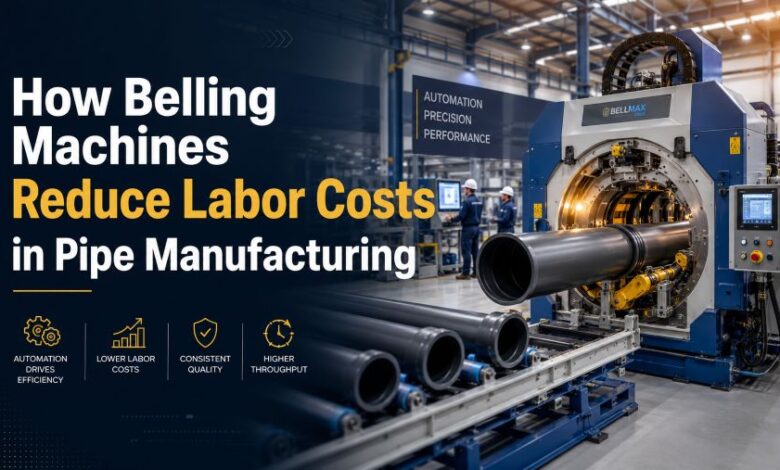
In plastic pipe manufacturing, labor costs directly impact production efficiency and profitability. Traditional manual pipe belling requires operators to heat, position, and form sockets, often leading to higher labor needs and inconsistent quality.
Belling machines automate the socket forming process, reducing manual work, improving efficiency, and ensuring stable production for PVC, HDPE, and other plastic pipes.
Reducing Manual Operations in Pipe Production
Traditional pipe belling requires workers to perform multiple repetitive tasks, including pipe feeding, positioning, heating control, socket forming, and quality inspection. For factories operating multiple production lines, these tasks may require several operators per shift.
A manual belling process may involve:
- 1–3 operators per production line
- Continuous monitoring during production
- Manual adjustment for different pipe sizes
- Additional labor for quality checking
With an automatic belling machine, many of these steps can be completed through mechanical feeding, automatic heating, precise positioning, and controlled forming. This reduces the number of workers required for daily operation and allows employees to focus on production supervision and maintenance.
Improving Production Efficiency and Output
Labor cost reduction is not only achieved by reducing workforce requirements. Increasing production efficiency is another important benefit of automation.
Manual pipe belling speed can vary depending on operator skills, fatigue levels, and working conditions. Automated systems provide stable processing cycles and consistent operation.
Depending on the pipe diameter and machine configuration, modern belling equipment can process:
- 20–100+ pipes per hour
- Different pipe sizes through adjustable settings
- Continuous production with reduced downtime
For example, a factory producing thousands of PVC pipes per day can significantly improve output by integrating belling equipment with extrusion lines. The automated process helps prevent bottlenecks between pipe extrusion and final product preparation.
Reducing Labor-Related Operating Expenses
Labor expenses include more than employee wages. Manufacturers also need to consider overtime payments, worker training, recruitment costs, and production interruptions caused by labor shortages.
Belling machines help reduce these indirect costs by creating a more automated manufacturing environment.
Common cost-saving benefits include:
- Lower dependency on skilled operators
- Reduced overtime during high-demand periods
- Less training required for new employees
- More predictable production scheduling
For companies operating large-scale pipe production facilities, these savings can become significant over the long term.
Improving Product Consistency and Reducing Waste
Manual belling processes may experience variations caused by temperature control, operator handling, or positioning errors. These variations can affect socket dimensions, connection quality, and final pipe performance.
Automated belling systems improve consistency through:
- Precise heating temperature control
- Stable forming pressure
- Accurate pipe positioning
- Repeatable processing cycles
Higher product consistency reduces rejection rates and material waste. For manufacturers using advanced Plastic Pipe Machinery, improving process control across the production line helps achieve better efficiency and lower production costs.
Enhancing Workplace Safety
Pipe manufacturing involves repetitive movements and exposure to heated components. Manual belling operations may require workers to frequently handle hot pipe sections, increasing physical workload and safety risks.
Automation reduces direct worker involvement in these repetitive tasks and creates a safer production environment.
Benefits include:
- Reduced risk of heat-related injuries
- Less repetitive physical work
- Improved workplace organization
- Easier production management
By reducing demanding manual operations, manufacturers can improve employee working conditions while maintaining production efficiency.
Supporting Flexible Production Requirements
Modern pipe manufacturers often need to produce different pipe diameters, lengths, and connection types according to customer requirements. Manual adjustments can increase labor time and reduce production efficiency.
Automatic belling machines support flexible manufacturing through adjustable parameters, allowing operators to change production settings more efficiently.
This flexibility is valuable for manufacturers producing:
- Water supply pipes
- Drainage pipes
- Underground pipeline products
- Construction and infrastructure pipes
With faster changeovers and reduced manual adjustments, factories can respond more effectively to different market demands.
Evaluating Return on Investment
Before investing in a belling machine, manufacturers should evaluate the relationship between equipment costs and expected savings.
A simple ROI analysis may include:
Annual Benefits = Labor Savings + Reduced Waste + Increased Production Value
For example:
Initial investment:
- Automatic belling machine system: US$50,000–150,000
Annual benefits:
- Reduced labor costs: US$40,000/year
- Lower production waste: US$10,000/year
- Increased output value: US$30,000/year
Based on production volume and operating conditions, many manufacturers can achieve a payback period of approximately 1–3 years.
Conclusion
Belling machines help pipe manufacturers reduce labor costs by automating repetitive socket forming operations, improving production stability, and reducing waste. By replacing labor-intensive processes with reliable automation, manufacturers can achieve higher efficiency, lower operating expenses, and stronger competitiveness in the plastic pipe industry.